Guess and test

THE ENGINEERING DEPARTMENT, Gabrielle Rish + Richard Langley, Moonah Arts Centre, Hobart, 15 September-14 October 2023
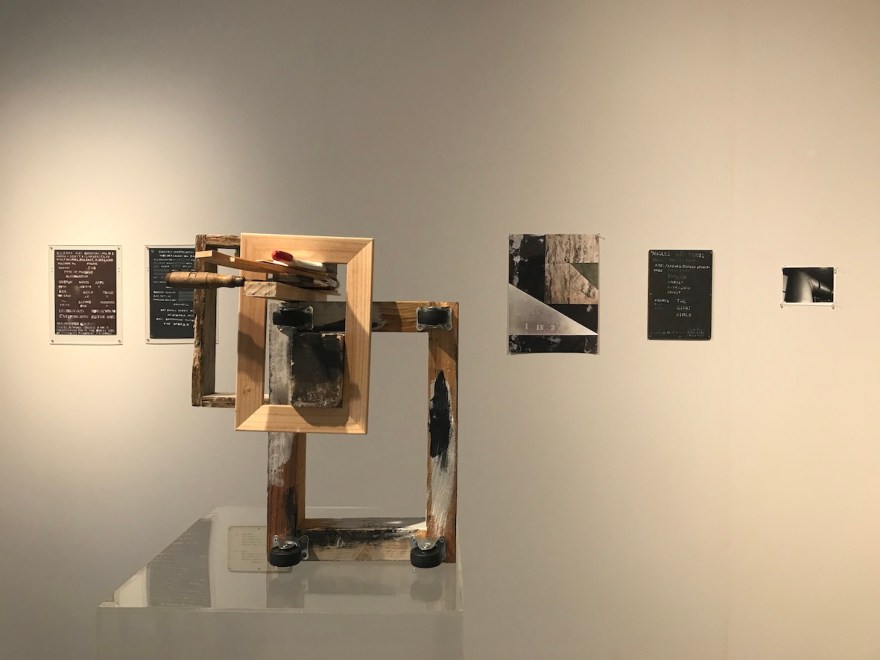
Mixed media sculpture by Richard Langley in front of works on paper by Gabrielle Rish

Sculpture by Richard Langley with ink drawings and photos by Gabrielle Rish

There is a relationship between those two great human undertakings, art and engineering.  Both disciplines are about process, about trying things out and testing materials, seeing what happens and what will work. In my installation-style exhibition with sculptor Richard Langley, The Engineering Department, I pay tribute to the precision and ingenuity of engineers’ problem-solving in my own imprecise way while Richard does so in his more elegant way.

Engineers deal with the monumental forces of nature on a daily basis as they work to build things that harness or withstand those forces and make human life more liveable. The incubator of this technical boldness in my part of the world is the University of Tasmania’s School of Engineering. I’ve know the School of Engineering for as far back as I can remember because my father was a lecturer there. The huge machines for crushing and smashing things, the weird pairs of copper spheres like people conversing with each other, except via static electricity,  the mathematical formulas chalked on boards, the smell of machine oil and white noise of generators formed a cross between a technological wonderland and my worst nightmare, made more so because maths and precision, the engineer’s stock in trade, did my girlish head in.  But I also loved the technology-age architecture – the reeded glass and wood veneer panelling of the offices, the golden mean-proportioned aluminium-framed windows and the isoceles triangle-patterned lino (the lino sadly covered by carpet just two years ago, but I have photos of it).

I walked back into the Engineering building when I had Latin classes there in 2019 and memories came flooding back. I decided to somehow document this elegantly utilitarian piece of post-war architecture and its contents, especially because the Engineering building and its big machines were slated for the scrap heap with the planned relocation of the campus to the city centre. I spent two weeks in residence in the engineering labs in early 2021, sketching and taking photos. And I was overawed by the machines and the precision of engineering all over again.

After a year of struggling with this big subject matter, I asked Richard if he would co-exhibit with me because his works are brilliantly engineered and he shares my fascination with manufactured objects and materials. It took him a few weeks to agree because he also found engineering a rather daunting subject. But eventually he began to see parallels between engineering and art. 

“I was hesitant about the subject matter initially,” Richard said. “I rarely have an outcome in mind when I begin working and I don’t see my work as being particularly logical or calculated. But visiting the School of Engineering and its collection of equipment for testing and measuring, it struck me that engineering tries things to see what happens. It’s about what works, just. The works I’ve made for The Engineering Department are the results of simple experiments. They are some of my initial observations of how these materials and forces can fit together, balance and resist. Their wonky and impermanent forms acknowledge engineering’s human basis.”

I drew in ink for this exhibition, focusing on the dials and nameplates of the machines. Ink can create very precise lines but it is a difficult medium to control due to factors affecting flow like evaporation, absorbency and gravity – engineering-type problems. As we worked in our separate spaces over the course of a year, only occasionally getting together to show and tell, Richard suggested that the imprecise quality that so frustrated me with my ink drawing was actually what spoke to him – it said something about the humanness of engineering. 

I found out recently that engineers have a saying, “guess and test”, whereas I had previously thought of them as god-like in their understanding. 

Andrew Harper, in his review of The Engineering Department, suggests the show sits ‘in traditions of Dada from the beginnings of the era of new’.  My work definitely looks back to a time when the world’s faith in engineers to solve humanity’s problems was at its highest.  But that faith has been replaced by a less confident emotion in the past 30 years: hope. Hope that engineers can come up with solutions to climate change, which the ceaseless inventiveness of engineers actually helped create. 

More images from the exhibition

Andrew Harper’s review of The Engineering Department (PDF)

Richard Langley website

Presence

Part of Toyota Lovers, in the window of the Moonah Arts Centre. Pic: Gabrielle Rish

My two-part work Toyota Lovers is on at the Moonah Arts Centre, Hobart, 4-26 June 2021. The work emerged from stumbling across a place where locals take cheap cars to race, crash, strip saleable parts from, then trash. I found a couple of Toyota Camrys among the wrecks and was hopeful I’d find a replacement for the damaged windscreen washer bottle of my own Camry. Unfortunately, the two I found were nothing like mine and didn’t fit. But what amazing things they were. 

Things … American academic Bill Brown, who developed Thing Theory, says that a commodified object becomes a thing once it ceases to function; it is only then that we can truly see it. That is the exact status of the Toyota water bottles I souvenired, along with a Mitsubishi horn cover and a Ford electronic key: they no longer do what they were carefully designed and manufactured to do, so they can now be considered as presences in their own right. 

Giorgio Morandi, Still Life, 1950, oil on canvas, 35x45cm

Discussion of found object art typically begins with Marcel Duchamp but I am more influenced by his Italian contemporary, still-life painter Giorgio Morandi. Morandi had a sensibility close to Indian and Japanese concepts of the life force manifest in the inanimate. As art writer Wolfgang Holler said: ‘In the end Morandi always revolves around the same complex of questions: what way of being is immanent to the objects that I see … How can I depict objects that does justice to the dignity of their aura, that comes close to their essence.’ Morandi’s bottles and jugs are radical declarations of objecthood. They resist associations; they have nothing to say to the viewer, though they are interacting intensely with each other. Their non-engagement throws us back on ourselves and we must look again and ask “what are these things”? And the answer is that these bottles and jugs just are, and that is quite a radical challenge to human subjectivity and the way we classify the living and the inanimate. 

Gabrielle Rish fettling (refining) porcelain casts in 2019. Pic: Melinda Antal

I cast all four of my found plastic car parts in porcelain for the following reasons. Firstly, I wanted to learn how to make moulds. There are around 30,000 individual components in a motor car, each formed in its own skilfully tooled mould. A four-piece mould was required to replicate the complex form of one of my plastic bottles. Far too difficult for a novice like me, this took my esteemed teacher, former UTAS Sculpture technician Ian Munday, half a day to make. The second reason I reproduced the four objects in porcelain was so that they could be seen more clearly as forms, rather than old plastic shit. The third reason was that even hard plastic will eventually degrade and disintegrate. But porcelain, which is clay with a very high silica content, will fire into a hard, inviolate and durable material. My porcelain car parts could be dug up 10,000 years from now and provide clues to understanding our time, just as contemporary archaeologists attempt to learn about ancient societies from the fragments they leave behind. To complete Toyota Lovers, one day I will take my porcelain casts back to the site where I picked up their plastic originals and bury them for posterity.

Toyota Lovers 5-minute narrated video on YouTube

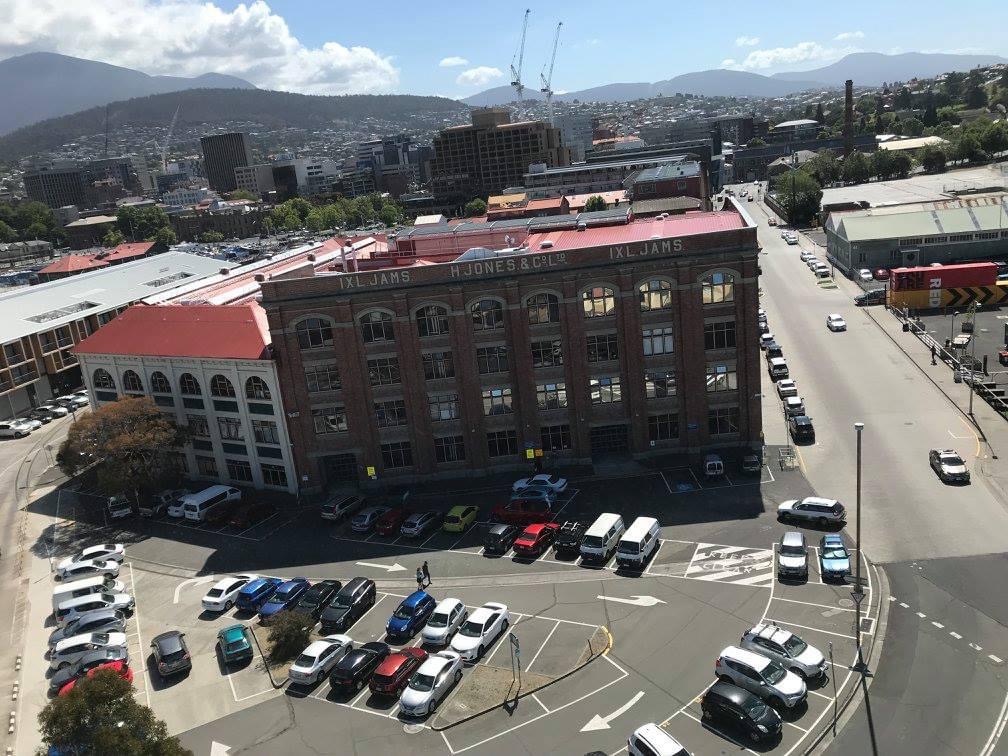
Goodbye to the art school

University of Tasmania art school, Hobart
University of Tasmania art school, Hunter St, Hobart: the building is an inspiration in its own right. Image: Gabrielle Rish

After two years of studying visual arts at TAFE and four years of a Bachelor of Fine Arts with Honours at the University of Tasmania, I have finally left the building. I went into the magnificent former IXL jam factory that is the Hunter St campus in 2015 as an absolute beginner in art (except for my habitual doodling with ballpoint pens in my reporter’s shorthand pads). I have emerged financially poorer but with a rich sense of the aliveness of the world. If you pay attention — and isn’t that what an artist does? — you will draw closer to the hidden mysteries and the external fascinations. The next step as an artist is to open those encounters to others.

I am currently part of a large group exhibition, Images of Tasmania 23, at the Salamanca Arts Centre and, in mid-January, my Honours cohort will show our work together in our own exhibition, Intimacy, at the Rosny Schoolhouse. I have a new art project taking shape and a solo show to work towards in mid-2021. I guess you could say I’m launched as an emerging artist.

But everything is always just beginning, especially as I’m an artist without a specialist medium. I find something I want to explore then work out the medium(s) to do that with, so I’m pretty much always an absolute beginner. To see this as a strength, rather than a weakness, I have to hold onto a way of thinking that I saw as the quote of the day on a “bunch of dates” desk calendar in my former working life: “If I were to wish for anything, I should not wish for wealth and power, but for the passionate sense of the potential, for the eye, which, ever young and ardent, sees the possible.” — Soren Kierkegaard.